Bond Market Signals Growing Anxiety as 10-Year Treasury Falls Below 4%
Investor nerves are on edge as the 10-year Treasury yield slips below 4% for the first time in half a year. With Trump’s tariffs jolting markets and Fed policy hanging in the balance, bond traders are bracing for a volatile spring. Is recession now the base case?
The benchmark yield on the 10-year Treasury note dropped below the critical 4% threshold Friday morning, its lowest level in six months. This move reflects mounting investor concern about the twin threats of slowing growth and sticky inflation, both sharpened by President Trump’s sweeping new tariffs.
The yield fell to 3.98% in early Asia trading and continued to hover under 4% as U.S. markets opened. It’s a significant milestone: breaching this level suggests investors are seeking safety in government bonds, even as the Fed remains hesitant to act.
A Tariff Shock and Its Ripple Effects
Trump’s announcement of a 10% blanket tariff on all imports, with steeper rates for key trading partners including China (54%), the EU (20%), and Japan (24%), sent markets into a tailspin this week. The fallout has been swift. Equities dropped sharply, with the S&P 500 shedding nearly 5% on Thursday alone. Meanwhile, the demand for Treasurys surged—pushing prices higher and yields lower.
Bond traders are now aggressively pricing in Federal Reserve rate cuts, betting on four quarter-point reductions this year, with the first expected in June. It’s a dramatic shift in expectations, made more urgent by fears that tariffs could derail an already fragile economic recovery.
“The distribution of possible outcomes has gotten flatter,” said Vineer Bhansali, CIO at LongTail Alpha. “Anything can happen.”
A Central Bank Caught in the Middle
This market move intensifies the pressure on Fed Chair Jerome Powell, who is slated to speak later Friday following the release of the March jobs report. With unemployment holding steady at 4.1% and job growth expected to cool slightly, the Fed faces a difficult balancing act.
“The Fed is in a tough spot,” said Gang Hu of Winshore Capital Partners. “If Friday’s payroll number is bad, the Fed man has to step in and provide support.”
Policymakers have maintained a cautious stance, citing a resilient labor market and stubborn inflation. But Trump’s tariffs may force a rethink, especially if consumer sentiment weakens and corporate investment slows.
Analysts warn that the unusual combination of higher input costs (due to tariffs) and weakening demand could drag the economy closer to recession—even as inflation remains above the Fed’s long-term target.
No Backstop in Sight
One reason for the market’s unease: neither the White House nor the Fed seems eager to act as a stabilizing force. “This is a unique point in time in which neither the administration nor the Federal Reserve are seen providing a backstop for stocks,” said Mark Hamrick, senior economic analyst at Bankrate.
That sentiment is echoed in Bankrate’s latest Market Mavens survey. While respondents expect the 10-year yield to settle near 4.08% by Q1 2026, they also caution that unpredictability in Washington could drive volatility—and bond yields—lower in the near term.
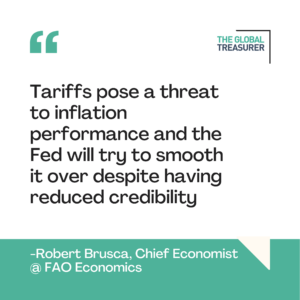
“Tariffs pose a threat to inflation performance and the Fed will try to smooth it over despite having reduced credibility,” said Robert Brusca, chief economist at FAO Economics.
Repricing Risk and the Yield Curve
In a sign of how investors are repositioning, the yield curve has steepened—suggesting that short-term rates are expected to fall faster than long-term ones. The gap between two-year and 30-year yields widened to 75 basis points Thursday, the highest since 2021.
For strategists like Bhansali, this presents a clear trade: “I’m buying two-year notes and selling 30-year bonds,” he said, betting on a sharp Fed response in the short term, even as long-term inflation remains sticky.
The Road Ahead
Friday’s nonfarm payrolls report and Powell’s speech could set the tone for markets heading into Q2. But the broader trend is clear: recession fears are rising, and the bond market is flashing warning signs.
Whether the Fed acknowledges these signals—or waits for more definitive evidence—could determine the economic trajectory for the rest of 2025. Until then, sub-4% yields on 10-year Treasurys may become the new normal in a market that’s no longer convinced the worst is behind us.