In-House Bank: A Guide for Treasury Management

In the ever-evolving world of treasury, corporations are constantly in pursuit of introducing innovative strategies that help refine operations, reduce cost, and optimize capital allocation.
An In-house bank is a unique treasury concept designed and implemented with a similar objective. It involves a corporate, centralized treasury-driven entity that functions like an external bank but exists entirely within the corporation. The In-house bank structures not only help achieve centralization of liquidity and standardization of payment and collection processes, but also help enable real-time treasury management
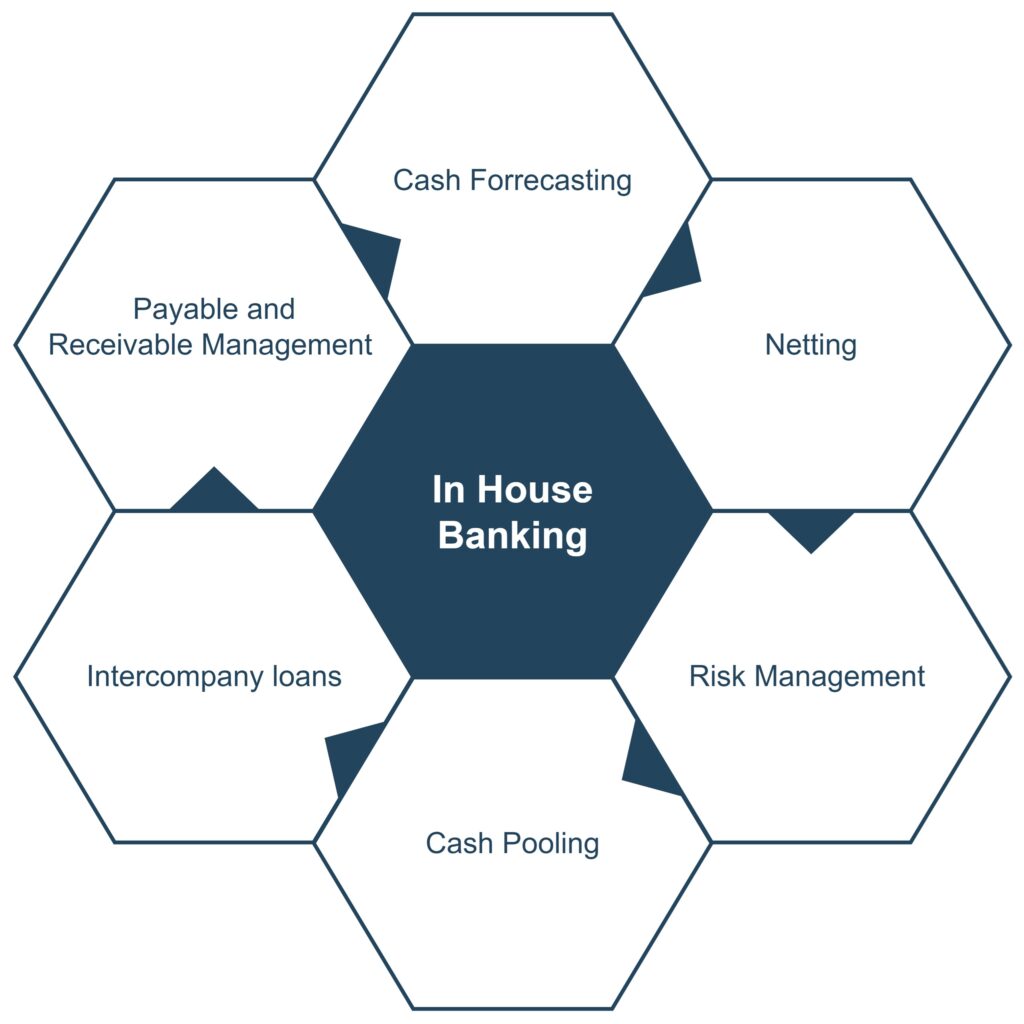
As part of the in-house banking proposition, outgoing payments/ incoming collections on behalf of subsidiaries are consolidated and executed centrally. This is achieved using a corporate treasury strategy wherein a central entity (In-House Bank) manages and makes payments/ receives collections on behalf of its subsidiaries through a single account, offering efficiency, transparency, and cost savings.
• Payments on behalf of [POBO] – Rather than each entity managing its own payments, the in-house bank—acting as a virtual internal bank—handles payment processing through centralized accounts. This streamlines workflows, reduces costs, enhances visibility, and improves control over corporate finances.
• Collection Receivables on behalf of [COBO/ ROBO] – The in-house bank acts as a virtual bank within the organization, offering collection services to affiliates much like an external bank would—but with significantly greater efficiency and control. This streamlines cash inflows, optimizes liquidity, reduces banking fees, and enhances cash visibility and control.
Cash pooling is a liquidity management technique wherein cash balances from subsidiaries/ business units are consolidated into a centralized account. This technique not only helps in maintaining and optimizing the overall cash flow across business entities but also helps maintain the working capital hydration requirement.
Cash Pooling can be broadly divided into two types:
• Notional Pooling – It offers centralized liquidity management allowing subsidiaries to maintain separate accounts while consolidating balances notionally for interest calculations purposes. Thus, resulting in enhanced interest optimization and reduced expenses over borrowings
• Physical Sweeping – Physical Sweeping also known as Cash concentration, involves the transfer of funds from subsidiary accounts to a central pool account. It offers advantages like improved cash visibility and reduced external borrowing costs
By integrating cash pooling within the in-house bank, companies can achieve centralized liquidity management by eliminating manual tracking, standardize intercompany funding, and optimize foreign exchange exposure while maintaining full treasury oversight.
From a treasurer perspective working capital management is all about managing short-term liquidity. Intercompany loan sweeping allows the treasurer to manage short term liquidity requirement by loaning/ sweeping funds from group companies at a reduced interest cost as against borrowing from external market resources (for e.g. banks) at a higher cost. In House banking helps achieve intercompany loan management by enabling subsidiaries to access internal funding instead of depending on external lenders. Streamlining the intercompany lending process helps optimize liquidity allocation, ensure compliance with financial regulations, and maintain structured oversight of financing activities.
Cash flow forecasting is the process of predicting future cash flows to ensure your business maintains proper liquidity. Automated cash forecasting helps finance teams anticipate cash shortages, optimize investment decisions, and plan for growth by analyzing accounts receivable, accounts payable, and other cash data over specific time periods. It is considered a vital tool for managing liquidity, avoiding shortfalls, planning investments, and making informed financial decisions.
As part of in-house banking, the centralized entity acting as a virtual bank provides a single unified cash forecasting view to the entire the organization. Thus, helping the entire organization achieve effective cash forecasting needs ensuring the organization has appropriate liquidity to finance its obligations and reduce the opportunity cost of lost investment yields on surplus funds.
Instead of each subsidiary managing FX exposures independently, using In-house banking the centralized banking entity consolidates, nets, and executes hedges centrally, ensuring a more coordinated and cost-effective approach to foreign exchange risk mitigation.
The In-house bank acts as a centralized FX risk management hub, offering foreign exchange hedging services to affiliates much like an external bank.
In-house bank functions as a central netting hub, consolidating invoices and managing cashflows, thus drastically reducing transaction costs, optimizing group liquidity, simplifying FX management, and increasing financial control by pooling funds and netting exposure within the corporate group.
The central entity in an organization acting as the In-House bank does not require a formal banking license or regulatory filings typically associated with external financial institutions. Using In- House banking treasury strategy the organization can significantly benefit from consolidation of cash balances, centralized FX operations, reliable fraud detection mechanism, real time reporting capabilities, data drive insights and robust Liquidity management techniques and thus can significantly enhance an organization’s ability to identify, assess, and mitigate financial risks.