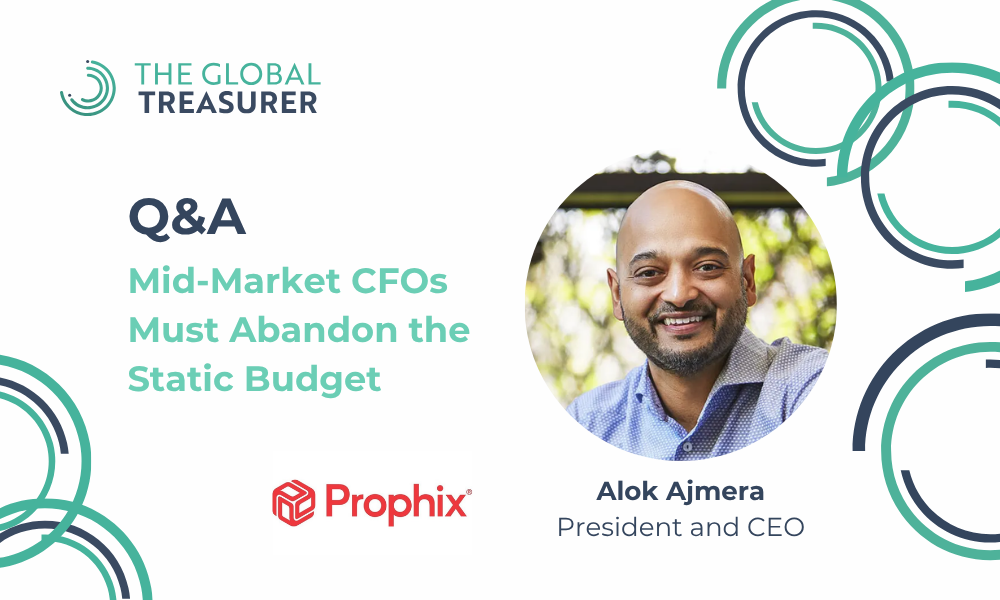
Why Prophix CEO Alok Ajmera Believes Mid-Market CFOs Must Abandon the Static Budget
In an exclusive feature, Prophix CEO Alok Ajmera breaks down how mid-market CFOs are resetting playbooks to balance cost discipline with targeted AI investments.

In an exclusive feature, Prophix CEO Alok Ajmera breaks down how mid-market CFOs are resetting playbooks to balance cost discipline with targeted AI investments.
Recent findings from the Richmond Fed’s CFO Survey paint a sober picture across corporate boardrooms: financial leaders’ macro optimism is dipping, and persistent cost volatility has returned to the top of enterprise risk lists. For mid-market finance teams, annual budgets and multi-year playbooks finalized just six months ago are rapidly losing their operational value.
Rather than treating today’s macroeconomic volatility as a temporary hurdle, mid-market organizations are discovering that static annual planning models are fundamentally broken. To understand how corporate treasurers, FP&A teams, and CFOs are adapting their strategies under margin pressure, The Global Treasurer spoke with Alok Ajmera, President and CEO of Prophix.
Having worked directly with hundreds of mid-market finance executives, Ajmera breaks down why static playbooks are being scrapped, where capital spending is shifting, and how leadership teams must navigate the gap between board-mandated AI ambitions and real-world execution.
The ongoing macroeconomic environment isn’t defined by a single shock, but by a continuous state of flux. Mid-market CFOs who designed their H1 strategies around expectations of market stabilization are finding that inflation and fluctuating cost baselines continue to erode operating margins.
“We’ve been operating in a consistent environment of uncertainty for a few years now,” Ajmera observes. “Everyone keeps expecting it to settle, but every year brings another set of macroeconomic challenges. I don’t think that’s going to change anytime soon.”
While inflation affects every enterprise differently depending on supply chains, labor exposure, and capital structures, the strategic response across the C-suite is uniform: static annual playbooks are being abandoned.
“What has changed across the board is the need to revisit assumptions more frequently as conditions change,” Ajmera explains. “Most CFOs are adjusting their plans rather than assuming the playbook they established at the beginning of the year still holds.”
Faced with direct margin compression, finance leaders are moving quickly to rationalize operating expenses. However, current budget adjustments are far from blanket austerity measures. Mid-market CFOs are making deliberate trade-offs to protect high-impact initiatives.
One of the primary targets for spending cuts is legacy technology and cloud infrastructure. Finance teams are aggressively auditing software stacks, consolidating vendor contracts, and eliminating redundant SaaS subscriptions to free up operational capital.
Crucially, the capital reclaimed from cloud optimization isn’t just being pulled back to protect quarterly earnings; it is actively being funneled into technology investments, specifically artificial intelligence.
“There’s still a lot of pressure to invest in AI, and some savings are being redirected toward AI initiatives,” Ajmera notes. “It’s really about being more deliberate with spending and where those investments can generate the greatest value.”
Despite tightening margins, AI and enterprise automation budgets remain heavily protected across the mid-market. This resilience is largely driven by top-down directives from CEOs and board members who expect AI deployments to unlock step-function gains in workforce productivity.
Yet, as Ajmera highlights, many finance organizations are experiencing a delay between initial capital outlays and measurable return on investment. This friction stems from a fundamental mismatch between software architecture and core financial discipline:
Deterministic Demands: Financial reporting, cash management, and compliance require absolute, 100% precision. There is zero tolerance for error in core accounting.
Probabilistic Software: AI models are inherently probabilistic, operating on confidence scores and predictive patterns rather than fixed math rules.
“Part of the challenge is that AI is inherently probabilistic while core finance processes are deterministic,” Ajmera explains. “The answer has to be correct 100% of the time in finance, and AI is catching up for application on sophisticated use cases. But there’s still confidence that as AI matures, it will be able to execute more complex finance workflows, and that’s what’s helping sustain the investment we’re seeing.”
To bridge this gap, Ajmera emphasizes that CFOs must move away from generic AI initiatives and insist on workflow-specific metrics. Targeting precise process bottlenecks where technology can safely deliver capacity relief.
The tension surrounding technology ROI is further amplified by changing workforce dynamics. Recent benchmark research from Gartner reveals a dramatic shift in hiring plans, with CFO expectations for annual headcount expansion collapsing from 6% down to just 2%.
| Operational Metric | Mid-Market Reality |
|---|---|
| Expected Headcount Growth | Slowed to ~2% (down from 6% in prior cycles) |
| Forecasting & FP&A Workload | Escalating demand for complex, continuous modeling |
| Technology Mandate | Shift from expanding staff to boosting per-employee output |
This structural slowdown in hiring creates a tough operational equation for the Office of the CFO. While headcount growth remains flat, executive boards are demanding higher-frequency cash flow modeling, faster month-end closes, and deeper scenario analyses.
While many organizations hoped AI would immediately absorb this extra workload, Ajmera notes that only a small portion of finance functions have realized that vision so far. However, he does not view this talent bottleneck as simple job displacement. Instead, it marks an evolution in the baseline skillsets required for modern corporate finance.
“Over time, I think we’ll see slower hiring as companies achieve more meaningful productivity per employee,” Ajmera observes. “But that doesn’t mean AI will just replace jobs. This actually gives organizations an opportunity to become more ambitious about what they can accomplish. Needed skillsets are changing, and the expectations for what individual employees can achieve are increasing as well.”
To maintain operational agility through continuous market disruption, corporate treasurers and FP&A leaders must adjust their day-to-day execution. Ajmera outlines three core focus areas for finance teams looking to build resilience:
Accelerate Reforecasting Speed: Accept that static annual models decay rapidly. Build processes designed around frequent assumption resets, allowing teams to adjust cash flow forecasts as market parameters shift.
Unify Operational Data Streams: Effective real-time scenario planning relies on trusted, centralized data feeds. Finance leaders must connect operational and financial datasets to model liquidity and capital allocation accurately.
Automate Data Assembly to Elevate FP&A: Direct automation tools strictly toward tedious, repetitive manual tasks. By reducing the administrative burden of forecast assembly, finance talent can pivot toward business advisory and strategic analysis.
“By the time a plan is finalized, the assumptions you started with may have already changed,” Ajmera warns. “In this kind of environment, the focus should be on increasing the speed at which teams can revisit assumptions and reforecast as conditions change. Leveraging AI frees up finance teams to spend less time assembling the forecast and more time on high-value activities that help the business understand what’s changed and what decisions to make next.”